Loading
water,
thriving
aquarium
Feed Your Fish and Not Your Algae
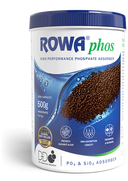
ROWAphos is available in 5 sizes: 100gr, 250gr, 500gr, 1Kg, and 5Kg commercial pack. It is a patented man-made ferric hydroxide material engineered for efficient removal of phosphate, silicate and arsenic from fresh and salt water aquariums and ponds.
ROWAphos has the largest adsorption capacity of any phosphate product worldwide and will not leach back into the water, improving water quality wherever phosphate or silicate is a problem.
ROWAphos is easy to use and saves the need for immediate removal once exhausted, while delivering highly efficient phosphate removal and improving water quality in marine and reef aquariums. ROWAphos should be replaced when no more phosphate can be bound; when phosphate concentration rises again, the material must be replaced.
Specifications
and main features
Extremely high binding capacity
Low space requirements
Quickly visible successes in the phosphate-related “algae plague”
Reduces silicate (SiO2)
Reduces phosphate excess to a natural level
No aluminum release or leaching, unlike alumina-based products
Avoids phosphate-related impairment of lime synthesis in calcareous red algae, stony corals, etc.
Also used in the drinking water sector for the removal of arsenic
NSF Certificate
Will remove 3ppm of phosphate (PO4) from specified water volumes depending on product size
Efficient removal of phosphate, silicate and arsenic
Largest adsorption capacity of any phosphate product worldwide
Will not leach phosphate back into the water
No release of pollutants
No pH value change
Suitable for both freshwater and saltwater aquariums as well as ponds

Specifications
Main Features
0.6 – 2.3 mm flakes
Shape
0.48 g/ml
Density
1.04 ml/g
Pore Volume (PV)
1000 m²/g
Total Surface Area (TSA)
990 m²/ml
TSA/PV
1000 mg/g
Small organic molecules adsorption
280 mg/g
Large organic molecules adsorption
>8
pH in distilled water
0.000001 g/ml
Phosphate output
Rapid removal of organic pollutants
High total adsorption capacity
Ultra-Low phosphate output
Ultra-Low ash content
Suitable for Marine & Freshwater
Filter Bag included( 250g, 500g, 1000g)
FAQ
Why use phosphate remover in a reef aquarium?
In reef aquariums, phosphates feed nuisance algae which can overrun corals and plants, spoil aesthetics, and in extreme cases kill inhabitants. Phosphates also reduce calcification by over 50% and inhibit coral skeleton formation, making phosphate removal essential.
How does ROWAphos clear water?
ROWAphos is an adsorbent material that binds phosphates and silicates and does not allow them to dissolve again.
What is ROWAphos made of?
ROWAphos is a high-purity synthetic material based on iron oxide hydrate (FeOOH) and water.
How does ROWAphos actually work?
ROWAphos is an adsorbent material based on iron hydroxide. It consists of iron oxide hydrate (FeOOH) and water. ROWAphos is made from high-purity synthetic material. It binds (adsorbs) phosphates and silicates, which it does not allow to dissolve again. Unlike some other phosphate removers, ROWAphos does not negatively affect aquarium water and can be used with sensitive fish and invertebrates in freshwater and saltwater aquariums.
ROWAphos is also used in drinking water treatment because, in addition to phosphate and silicate, it also removes arsenic extremely effectively. Thanks to our material, compliance with the strict arsenic limit values for drinking water in Germany is possible in many waterworks.
Use of ROWAphos in the fluidized bed reactor
ROWAphos is being used more and more frequently in the fluidized bed reactor. The advantage is obvious: due to the very good contact of the granules with the seawater, the adsorption capacity is improved even further.
You can find out the best way to set it and other tips in this YouTube video by The LAB: ROWAphos and how it works.
How often do I need to replace ROWAphos? When is the material exhausted?
In general, no general information can be given on the service life of the filter material since the service life depends on the phosphate content of the respective basin. The phosphate content in the basin does not only depend on the concentration of the basin water. Often, for example, a lot of phosphate was stored in the substrate and in the decoration due to precipitation reactions. This phosphate slowly dissolves again and can lead to a significant increase in the phosphate concentration in the aquarium water.
ROWAphos binds the phosphate dissolved in the water quickly and extremely efficiently. The decrease in phosphate concentration is easily traceable and measurable with a good drop test. When the material is exhausted, i.e., no more phosphate can be bound, the concentration slowly rises again. This increase is caused exclusively by the formation of new phosphates (e.g., by the demineralization of organic matter) and by bound phosphate. ROWAphos produces no phosphate. As soon as you measure an increase in phosphate concentration, ROWAphos must be replaced.
Many commercially available phosphate tests are only of limited significance at low concentrations, especially in the seawater sector. We therefore recommend using a test that provides reliable and reproducible results, especially at the low phosphate concentrations required in seawater aquariums.
Problems with diatoms – Silicate
Question
Unfortunately, after removing all bottom-living algae eaters, I have problems with diatoms. Even the use of hardened osmosis water only helps to a limited extent in my 140-liter freshwater aquarium. It is clear to me that there are a number of other parameters that affect the growth of algae.
1. Why am I not allowed to rinse ROWAphos before insertion? Unfortunately, I did, albeit briefly.
2. The manual says nothing more about the SiO2 binding. To what extent is SiO2 bound?
3. Can I safely leave the phosphate absorber in the filter? Is there a residual amount of phosphate left in the aquarium that is needed by the plants?
Thank you very much for your responses and greetings.
PS: In the pet store, I was alerted to the problem of polyphosphates in drinking water. What is the significance of this connection in drinking water treatment, and what are the consequences for aquaristics?
Answer
Unfortunately, silicate is not as well retained by reverse osmosis systems as other substances. On average, about 20–30% of them pass through the membrane and are found in the permeate. Depending on the initial concentration in the raw water, this can lead to problems. That seems to be the case with you.
For your questions:
No problem rinsing out ROWAphos.We used to have customers who poured the material into a kitchen colander and then complained that there was nothing left. Careful rinsing is completely fine.
We do not specify capacities because they always depend on the initial concentrations, flow conditions, contact times, phosphate content, etc. and are therefore different in each tank.
Our marine aquarists always run their tanks permanently without any problems with ROWAphos. In fresh water, it depends. As a rule, we also recommend continuous use here. Of course, if you have an aquarium with a lot of plants, they need a little phosphate to grow. However, due to mineralization and the addition of feed, they have a constant phosphate input. You should measure the phosphate concentration regularly and not overdose on ROWAphos.
Polyphosphates and silicates are used by the waterworks to protect the pipeline network. They are very well retained by the RO membranes. Biologically, the polyphosphates in the drinking water are not available for the time being. They must first be broken down into orthophosphate and then enter the cells via transport systems (our energy storage at the cellular level also takes place via polyphosphates!).
Phosphate Test Scale
Question
I have a Rowa phosphate test.
In this test, two values are displayed on the scale. Is it correct that the first row of scales does NOT show the phosphate value usual in aquatic organisms, but the second row does?
How can I interpret the measurement result correctly if I want to determine the PO4 value of the water sample?
Answer
As you correctly assumed, the bottom line shows the phosphate value. The upper line, the lower value, indicates the phosphorus content of the phosphate compounds in the water.
The free (= ortho-) phosphate is determined by the test. The phosphorus content of the phosphate compounds (PO4-P) is then determined via a conversion factor.
So you can read the phosphate content directly on the bottom line.
Does ROWAphos work like an ion exchanger?
Question
Your review of the new ROWAphos convinced me; I will opt for this product. I was very skeptical because I maintain a large discus aquarium.
You mention that your preparation must be kept “moist.” I assume that this is the same principle as “ion exchange resins,” that is, it emits a substance in order to be able to bind phosphate and silicate? What kind of fabric is this in this case? Thank you very much for your message.
Answer
No, ROWAphos does not work like an ion exchanger. In the case of an ion exchanger, the process is just “exchanged.” ROWAphos adsorbs, i.e., binds, the phosphate without exchanging it for anything and does not release it again.
In the case of an ion exchanger, the bound ions can dissolve again when all the “binding sites” are occupied. In the worst case, such a filter “breaks through,” i.e., more of the substance to be removed gets back into the water than was originally contained in the water. This does not happen at ROWAphos.
Refill pack phosphate test
Question
Where can I get the refill pack for the Rowa phosphate test item no. 1.20066.0001?
Answer
Unfortunately, the refill pack is no longer available.
Replacement tubes for phosphate test
Question
Unfortunately, one of the glass tubes fell off from your phosphate test. I didn’t want to buy a new one because the test had barely been used. Can the glass also be purchased individually?
Answer
Please contact a pharmacy or a laboratory dealer. You can get a corresponding tube there. The order number of the tube can be found on the instruction manual.
ROWAphos completely moist
Question
I wanted to exchange my ROWAphos today. However, when I opened the package, it was completely damp due to condensation. The package was left unused in the closet for about 3 months. Can I still use the phosphate adsorber, or should I buy a new one?
Answer
ROWAphos is always damp and must also be stored in a damp place. If it dries out, you can still use it, but the capacity (i.e., the amount of phosphate that is bound) decreases.
So, don’t worry, it’s all right.
Usage Tips
ROWAphos is often used in fluidized-bed reactors because the improved contact between the granules and seawater can further improve adsorption capacity.

Why Use Carbon
in a Reef Aquarium?
How activated
Carbon clears water?
What is
activated Carbon?
Which Carbon
is ideal?
Why Use Carbon in a Reef Aquarium?
Reef aquariums are closed ecosystems where organisms produce organic waste—proteins, fats, carbohydrates, acids, and phenols. If left in the water, these organics fuel unwanted microorganisms, increase oxygen demand, lower Redox potential, raise CO₂ levels, reduce pH, and encourage nuisance bacteria and algae. They also impair light penetration critical for coral growth. Strong protein skimming, fine mechanical filtration, and healthy biological filtration handle large particles, but many small organics can only be removed effectively with activated carbon.
How activated Carbon clears water?
Scientifically speaking, carbon removes organic compounds from water through a physical process known as adsorption. In a reef aquarium, the submicroscopic pores of activated carbon represent the final stage of mechanical filtration, adsorbing organic molecules that are too small to be captured by even the finest filter media or physically removed by protein skimming.
Adsorption can be described as the adhesion of molecules to a surface by attractive forces. Within activated carbon, this occurs inside its vast network of submicroscopic pores, where the attractive forces between the organic molecules and the carbon’s internal surfaces are stronger than the forces keeping those molecules dissolved in the water. This process continues until the available surface area is fully occupied and the carbon becomes saturated with organics.
What is activated Carbon?
Activated Carbon is an extremely porous material with a sponge-like structure and a very large internal surface area relative to its physical size. It is produced from a variety of organic materials with high carbon content, such as coconut shells, nutshells, lignite, bituminous coal, or anthracite. The Carbon-based material is “activated” through physical modification and thermal decomposition in a furnace, under a carefully controlled atmosphere and temperature.
The activation process significantly increases the surface area per unit volume by creating a fine network of submicroscopic pores, which gives activated Carbon its ability to function as an effective filter material. The source material and activation process determine the physical characteristics of the finished product. There are many different grades of activated Carbon, each designed for specific applications and performance requirements.
Which Carbon is ideal?
There are a number of internationally accepted tests for evaluating and comparing activated Carbon. However, the most significant parameters for selecting a Carbon for reef aquariums are the Iodine Number and Methylene Blue Number. These two parameters measure the ability of the Carbon to adsorb organic waste from a reef aquarium that is not removed by mechanical filtration or protein skimming. The higher the number, the more organics will be removed per gram of active Carbon used. Both of these numbers are equally important and should always be considered together when evaluating test data.
Some manufacturers quote a Molasses Number; however, molecules in the molasses size range are typically removed by protein skimming, making this number irrelevant when evaluating the suitability of activated Carbon for reef aquariums.
In the past, Carbons have been known to leach phosphate into the water, which is undesirable for a reef aquarium. Therefore, lower levels of Leachable Phosphate are preferred. In reality, as long as leachable phosphate is below a basic threshold, differences below that level are not measurable in reef aquariums and are irrelevant.
The cleanliness or dustiness of the product is also a consideration and is measured as the Ash Level. Lower ash levels are better, as higher levels indicate more particles released into the water and less active Carbon remaining to perform filtration. Ash levels are often quoted by manufacturers, but the easiest way to visualize it is by observing the turbidity when adding the Carbon to water.
In addition to these important indicators, the overall efficiency of activated Carbon will be affected by its physical parameters, such as Product Density, TSA, Pore Volume, and Mesh Size.
Activated Carbon produced from lignite and anthracite is not recommended for reef aquariums due to excessive fine powder released into the water, which may lead to lateral line necrosis (“HLLE disease”) in some fish. Coconut shell or bituminous coal are the preferred sources.
Technical terms
Iodine Number
Standard testing done to estimate the adsorption capacity of small molecules, in the range of 10 Å to 15 Å. Recommended levels for reef aquariums are above 850 mg/g but the higher the number the better.
Methylene Blue Number
Standard testing done to estimate the adsorption capacity of medium size molecules in the range of 15 Å to 40 Å. Recommended levels for reef aquariums are above 250 mg/g but the higher the number the better.
Molasses Number
Non-standard testing done to estimate the adsorption capacity of large molecules above 40 Å. There is no recommended level for reef aquariums these molecules are removed by protein skimming.
Leachable phosphate
A measure of the amount of residual orthophosphates PO4 that may leach from the Carbon to the aquarium. The less phosphate the better and for reef aquariums should be below 10 mg/kg. Highest quality Carbons will be below 2 mg/kg.
Ash Level
A measure of the non-Carbon content of the activated Carbon. This is normally a dust that will be released from the Carbon to the water. The less Ash the better.
Product Density
Density of the Carbon at maximum packing efficiency, reported in g/ml.
TSA – Total Surface Area
Amount of pore surface available for adsorption for a given mass of Carbon, measured using techniques such as BET nitrogen adsorption; reported in units of m²/g. Recommended levels are above 800 m²/g.
Pore volume
The amount of macro, meso and micro pores. The ratio between TSA to pore volume estimate the active surface area in m2/ml.
Mesh Size
Measure of particle size range of the granular product. Recommended mesh size for water treatment is 8 x 30 mesh (0.6 x 2.4 mm).
ROWA Phos Performance Comparison
In independent tests by Berlin Technical University, ROWAphos was found to be the most efficient phosphate remover, outperforming other medias which reached only 30–40% of its capacity.
Overall Rating

A
B
C
D
E
F
G
Performance Comparison
Testing by Berlin Technical University confirmed higher efficiency and continued phosphate removal at lower concentrations with higher maximum holding capacity.

Join our Facebook Group
The largest, fastest growing community of Red Sea reefkeepers sharing tips, experience & insights
Let’s reef!
Join our Facebook Group
The largest, fastest growing community of Red Sea reefkeepers sharing tips, experience & insights
Let’s reef!